

PTSD is often described in terms of stress, memory, and the nervous system. Moral Injury goes one step further: it is not only about what someone experienced, but about what it did to their inner moral compass.
People describe it as a rupture in meaning. Guilt that does not fade. Shame that becomes embedded. Or a sense of alienation from themselves, others, or life itself.
In that space where language falls short, unexpected sources of meaning sometimes emerge. Not as solutions, but as mirrors. The life of Francis of Assisi is one example.
Who was Francis of Assisi?#
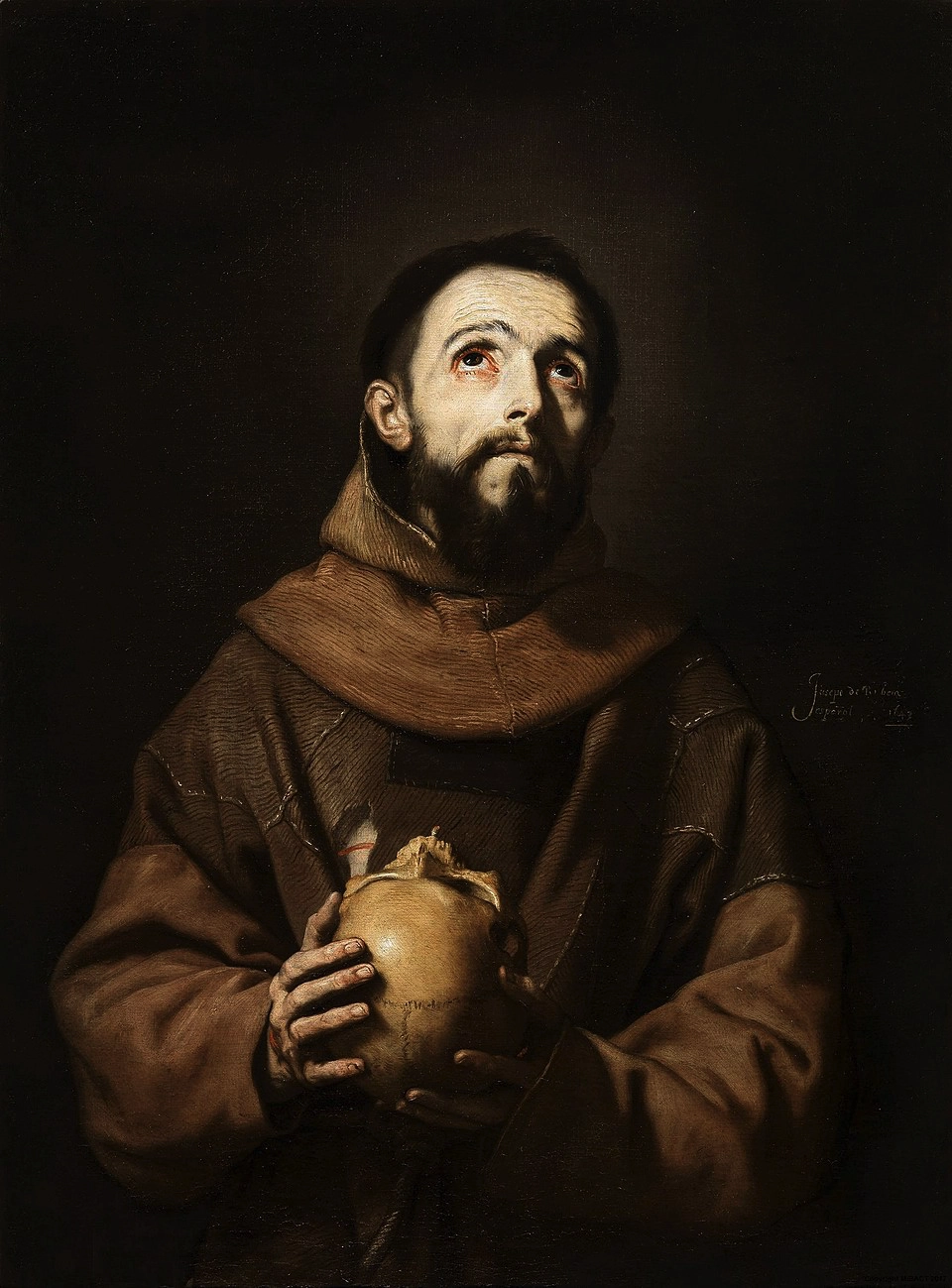
Francis of Assisi (1181–1226) grew up in a wealthy merchant family in Italy. He lived in a world of ambition, status, and social expectations. His early life revolved around ideals of honor and success.
But his life path changed abruptly. War, imprisonment, and illness brought him into an existential crisis. The identity he had built collapsed.
What emerged afterward was not a return to his old life, but a radical reorientation. Francis chose simplicity, poverty, and closeness to people pushed to the margins of society.
His spirituality was not centered on abstract ideas, but on concrete humanity: living simply, caring for the vulnerable, connection with nature, peace and reconciliation, and radical equality.
Moral Injury: when the moral compass breaks#
Moral Injury is not an official diagnosis, but a concept increasingly used in research on war, policing, healthcare, and crisis situations.
Researchers such as Jonathan Shay and Brett Litz describe Moral Injury as an inner rupture that arises when someone does something that violates deeply held values, witnesses moral violations, or feels betrayed by authorities or systems.
The result is often not a classic fear response, but guilt and shame, inner alienation, loss of trust, and existential emptiness.
What Francis can show us about PTSD and Moral Injury#
It is important to stay clear-headed: Francis is not a therapeutic method. His life is not a treatment protocol. But his attitude does offer a different perspective on recovery.
1. From identity to reorientation#
Francis lost not only certainty, but also his former identity. That resembles what many people with trauma experience: the old self no longer works.
Instead of trying to repair it, he chose reorientation. Not back to who he was, but forward toward who he could become in relationship to life itself.
2. Simplicity as protection against inner noise#
After trauma, inner life can become chaotic: thoughts, images, memories, tension.
Francis lived with radical simplicity. Not as a romantic ideal, but as a way of reducing noise. Simplicity then becomes not aesthetics, but stability.
3. Moving toward what is avoided#
One of the best-known stories is his encounter with a leper. Where he initially felt disgust, compassion and closeness gradually emerged.
In trauma terms, you could say: he moved toward what he had first avoided. Not through force, but through a gradual shift in attitude.
4. Restoring connection#
Moral Injury is often about broken connection: with people, community, or moral order.
Francis chose radical connectedness — with the poor and sick, with nature, with everyday life. Not as theory, but as a practice of closeness.
What does scientific research say about this?#
The connection between spirituality, meaning, and trauma is being studied more and more.
Important insights come from:
- Bessel van der Kolk – describes in The Body Keeps the Score how trauma becomes embedded in the body and how recovery often unfolds through experience, rhythm, and relationship.
- Jonathan Shay – introduced Moral Injury in relation to Vietnam veterans and emphasized the importance of restoring trust and community.
- Brett Litz et al. (2009) – describe Moral Injury as a disruption of moral frameworks leading to guilt and shame.
- Research into existential and spiritual care in psychology (including Kenneth Pargament) shows that meaning-making is an important factor in recovery processes.
What stands out is this: recovery is not only about reducing symptoms, but also about meaning, relationship, and integration.
Mysticism as a supportive layer, not a solution#
Francis shows something that is deeply mystical, yet also very grounded.
Mysticism here does not mean escaping reality. It means remaining present with what is, without immediately trying to fix or solve it, with attention to connection.
For PTSD and Moral Injury, that can mean making space for what is felt — without being overwhelmed by it, and without denying it. It is not a replacement for therapy, but it can become an additional layer in which meaning slowly begins to take shape again.
The tension between pain and meaning#
What makes Francis interesting is that he does not begin from “solution,” but from relationship.
His life suggests something simple: pain does not first have to disappear before humanity can be experienced, meaning can emerge in the middle of vulnerability, and connection is often more important than control.
That is not a romanticization of suffering. It is more an acknowledgment that recovery is rarely linear.
A personal note: the Pulsar line#
The fact that both Francis of Assisi and Rumi have their own posts on this site is no coincidence. Marcel Derkse, the inspirer behind the Pulsar Academy and the translator who brought Rumi’s Masnavi into Dutch, drew from both traditions. For him, Francis and Rumi did not stand opposed to one another, but side by side: two men from the same thirteenth century, from completely different religious traditions, each showing in their own way how a human being can remain human in vulnerability.
My own introduction to Francis came through that Pulsar line. That is why this post places more emphasis on the practical, embodied, and relational dimensions of mysticism than on purely historical or doctrinal aspects. Not because those are unimportant, but because in the tradition through which I encountered Francis, they were always connected to living, breathing, practicing, and community.
Read also#
- Rumi and PTSD and Moral Injury
- What is the difference between PTSD and Moral Injury?
- Post-traumatic growth
- Silence and PTSD
- Shame after trauma
Conclusion: a different language for recovery#
Francis of Assisi offers no method for PTSD or Moral Injury. What he does offer is a different language.
A language of simplicity, closeness, and connection. A way of living in which vulnerability is not immediately treated as a problem to be solved, but as a reality in which humanity can emerge again.
In a time where trauma is often approached through protocols and systems, his life reminds us that recovery can also be something else: slow, relational, and deeply human.
Questions?#
Do you recognize this in yourself or in your work with others? Use the contact form to get in touch with me.