

Our body cannot be anywhere other than here and now.
That is a simple sentence, but it carries far-reaching consequences. For if the body is always here, and thought can be anywhere except here, then the entire dynamic of trauma is contained in that gap.
At the scene itself#
As a police officer, I attended several highly distressing incidents. There I stood. One of those cases — a case of child abuse with a fatal outcome — I have never forgotten.
In a moment like that, you cannot express your emotions. That is not functional. I was there to help, to resolve something, to record what needed to be recorded. I had to defer my emotions. I acted from my mental strength, my frame of reference and my training.
Back at the station, I had to write an official report. There too there was no room for emotion. Only for the grounds of knowledge: a factual description of what I had seen. However harrowing that sometimes was.
An event like that stays with you for days. There are some I still carry, and whose memory surfaces at unpredictable moments. How I respond then depends on what is happening around me. First comes the mental: my frame of reference places what has surfaced. Then come the emotions. Sometimes I cry. Sometimes I become angry. Usually I go quiet. And then there is the body: tension in my neck, my shoulders, my abdomen.
That is precisely what the Law of Four describes. Not as a theory. As an experience. The framework I use comes from the Fourth Way of G.I. Gurdjieff and P.D. Ouspensky.
What is the Law of Four?#
In the Fourth Way, Gurdjieff distinguished three centres: the physical, the emotional and the mental. Above these — or better: within them — he placed a fourth layer, which he usually referred to as “I” (the I), the essence, or in older language: the soul. Not as a religious concept, but as a regulating conscious centre that can integrate the other three when it has been developed.
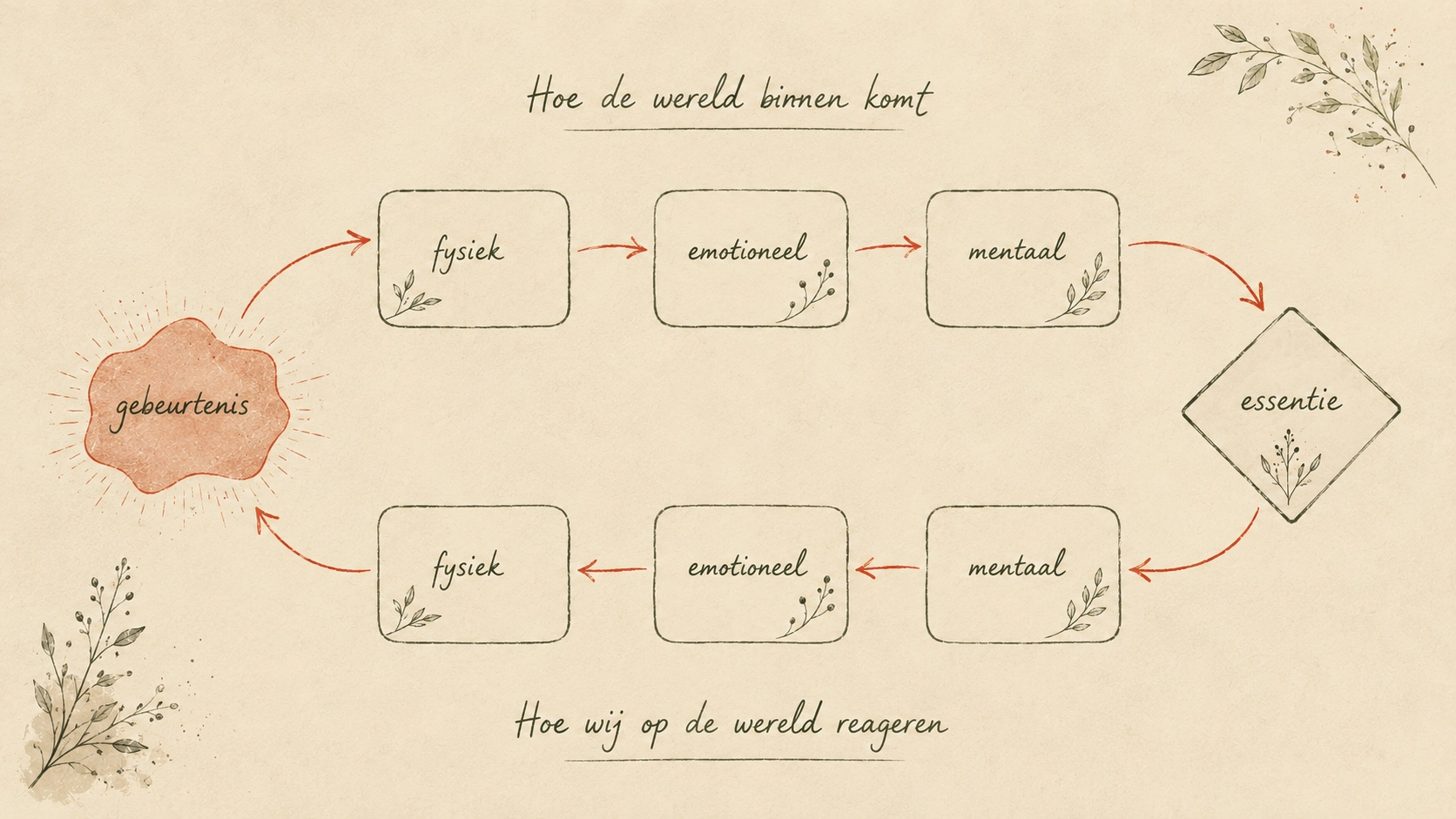
The four layers do not function independently. They form a cycle that moves in two directions:
- How the world enters us — from outside to inside, bottom-up: first body, then emotion, then thought, then something that settles into the essence.
- How we respond to the world — from inside to outside, top-down: first checked against the frame of reference, then emotion, then the body moving into action.
Understand these two movements and you understand much of your own behaviour. You also understand why (self-)awareness is important for recovery.
How the world enters us#
Every event is first registered physically. Through the senses: hearing, sight, touch, smell, taste. That is biology. Before you think anything, before you name it, your body has already registered it.
Only then do emotions form. Sometimes consciously, often unconsciously. A sense of safety or threat, pleasantness or aversion, calm or unease. Researcher Stephen Porges calls this neuroception: the nervous system evaluates whether something is safe before consciousness is even involved.
Then comes thought. It orders what has been received, links it to memories, gives it language, places it in context.
What body, emotion and thought together register settles somewhere still deeper. This is what the Fourth Way calls the essence or soul. From this, the frame of reference builds up: the whole of beliefs, habits and meanings with which you will assess further experiences.
A feeling that arises in our head or our body translates itself into chemical compounds that are released somewhere. Organs, tissue, skin, muscles and glands: they all have protein receptors and the capacity to store emotional information. Unexpressed and unconscious emotions are literally stored in the body.
There lies the first key: the storing happens on multiple levels simultaneously. What thought cannot — or cannot yet — place is stored elsewhere. Often in the body.
How we respond to the world#
The response also unfolds in four steps, but in reverse.
When something happens, it is almost instantaneously checked against our frame of reference. Three possible outcomes:
- good for me
- neutral for me
- bad for me
This checking is usually unconscious. It takes milliseconds. Only then do emotions arise that match that assessment: joy, neutrality, fear, anger. And then the body moves into action: tension, relaxation, fleeing, freezing, approaching.
In healthy regulation, these steps connect smoothly. In trauma, this chain is disrupted.
What dissociation is in this model#
A common response to overwhelming experiences is dissociation: thought leaves the scene while the body continues to take everything in. “I wasn’t really there.” “It was as if I were watching myself from above.” “I only know that it happened, but not what I felt.”
In the language of the Law of Four: the mental withdraws from the bottom-up cycle. The body keeps registering, emotions form unconsciously, but the integration into thought and essence is suspended. What remains is fragmented storage: a bodily trace, but no coherent narrative.
This explains why people with trauma sometimes have very strong physical reactions without any clear memory. The body remembers what thought was unable to experience.
What trauma does to the cycle#
Trauma arises when we are unable, or insufficiently able, to recover from what we have absorbed. The four layers then continue to function in a disconnected way. Three common patterns:
1. The body keeps reacting; thought no longer knows why#
In PTSD, the body responds to triggers that thought has long since assessed as harmless. The input cycle has become anchored, but integration has remained incomplete. Talking alone rarely helps. Thought is not where the information is stored.
2. The frame of reference breaks#
In moral injury, it is primarily the fourth layer that is damaged: the essence where your values reside. It is not so much fear that dominates, but confusion and shame. Who have I become through what I did or witnessed? The top-down cycle becomes unreliable because the compass itself has been struck.
3. The checking becomes hypersensitive#
In chronic stress or complex trauma, the filter of “good–neutral–bad for me” becomes hypersensitive. Almost everything feels like a threat. The emotions that follow are intense; the physical responses are exhausted.
What this means for recovery#
The Law of Four shows why talking alone is often not enough. Talking operates at the mental level. But if the information is stored in the body, work must happen there too.
This is why modern trauma recovery draws on approaches that address multiple layers:
- Breathing exercises — regulating the body
- Body-oriented therapy (Somatic Experiencing, Sensorimotor Psychotherapy) — body and emotion
- EMDR — reconnecting emotional charge with thought
- Cognitive therapy — thought and frame of reference
- Self-remembering and attention (Fourth Way) — strengthening the conscious centre
- Co-regulation through safe relationships — all layers at once
No single method is sufficient on its own. The Law of Four explains why: recovery requires connection between body, emotion, thought and essence. What has become disconnected must learn to work together again.
The bridge to the Fourth Way#
Gurdjieff proposed that most people live without a developed conscious centre, without the “I” that can integrate the other three centres. We react mechanically, from habit and pattern. Trauma intensifies that mechanicality. Reactions become more automatic, less chosen.
His work revolves around the gradual building of that regulating centre. Not by learning something new, but by learning to be present with what is already happening — in body, feeling and thought simultaneously.
For people recovering from trauma, this is a hopeful perspective. It is not a new task. It is the recovery of something that was already yours, before the cycle broke.
What the Law of Four is not#
In the interest of balance — as with the other models on this site — a few honest observations.
- It is not a clinical model. The Law of Four comes from a spiritual tradition, not from medicine. It does not explain DSM criteria or prescribe a treatment protocol.
- The four layers are not sharply delineated biological structures. It is a working model, not an anatomical map. Modern neuroscience describes these processes differently and more precisely, using terms such as interoception, the default mode network, and the HPA axis.
- The term “soul” is a choice, not a fact. If the word feels uncomfortable, read “essence”, “I”, “conscious centre” or “core” instead. The function remains the same.
- It does not replace therapy. Understanding this model may help a reader make better sense of their own experience, but recovery usually requires professional guidance.
Frequently asked questions#
Why does this differ from the three-brains model?#
The three-brains model describes the three centres (head, heart, gut) as three forms of intelligence at rest. The Law of Four adds two things: the fourth layer (essence/soul as regulating centre) and the cycle between the layers — in both directions.
How does this relate to polyvagal theory?#
Polyvagal theory explains how the autonomic nervous system switches between three states of safety and danger. The Law of Four is about how experiences move through the layers and how they are stored. The two models complement each other: Porges explains what the nervous system does; the Law of Four explains how that information is then integrated — or not.
Is “soul” the same as consciousness?#
In Gurdjieff’s usage, not quite. Consciousness is broader and graduated — there are levels of consciousness. The I or essence is, in his model, what remains when all learned roles fall away. It is closer to something like “the core of who you are” than to ordinary alertness.
What do I do if this model resonates with my experience?#
Discuss it with your therapist, or use it as a compass when making choices in your recovery. Ask yourself: where does my work lie right now — in my body, in my emotions, in my thought, or in my frame of reference? The answer differs depending on the phase you are in, and is rarely in only one layer.
Can I practise this without a teacher?#
Understanding the model, yes. But building a conscious regulating centre is a lifelong undertaking for which the Fourth Way traditionally recommended guidance. This site offers an introduction; for deeper study I would recommend In Search of the Miraculous by Ouspensky.
In closing#
With the knowledge I now have, after a distressing event I would also write a second report at home. Not for the case file. For myself. A report of what I felt, of what my body was carrying, of what thought could not yet place.
It would not have been a solution. But it would have been an honest beginning of processing.
For those who work — or have worked — in comparable professions (police, military, emergency services): this can have a place for you too. Do not only write what happened. Write also what it did to you.
Trauma is not a short circuit in one part of the system. It is a disruption of the coherence between body, emotion, thought and essence. Recovery does not begin with “finding the right thought” or “doing the right exercise”. It begins with reconnecting. Body with feeling. Feeling with thought. Thought with the place where we know who we are and what we value.
The body cannot be anywhere other than here and now. There it waits.
Further reading#
- Three brains, one person — the three centres at rest
- Polyvagal theory of Porges — what the nervous system does unconsciously
- The Fourth Way — the broader framework of Gurdjieff
Sources and academic publications#
- Gurdjieff, G.I. (1950). Beelzebub’s Tales to His Grandson
- Ouspensky, P.D. In Search of the Miraculous
- Pert, C. (1997). Molecules of Emotion
- Porges, S.W. (2011). The Polyvagal Theory
- Van der Kolk, B. (2014). The Body Keeps the Score
- Damasio, A. (1999). The Feeling of What Happens
Questions?#
Do you recognise this in yourself or in your work with others? Use the contact form to get in touch with me.