

Neuroplasticity in (Complex) PTSD and Moral Injury: How the Brain Learns New Pathways#
When old alarms keep going off#
Some people live for years after an event as if the danger never ended. The body startles, the mind scans, sleep fractures, relationships become tense. In complex PTSD and moral injury, this is not weakness. It is often a brain that once adapted brilliantly to unsafe circumstances — and now keeps repeating that adaptation for too long.
That is exactly where neuroplasticity becomes interesting. Not as a miracle word. Not as a quick fix. But as a sober and at the same time hopeful truth: the brain can change for as long as we live.
What has been shaped can also be reshaped.
What is neuroplasticity?#
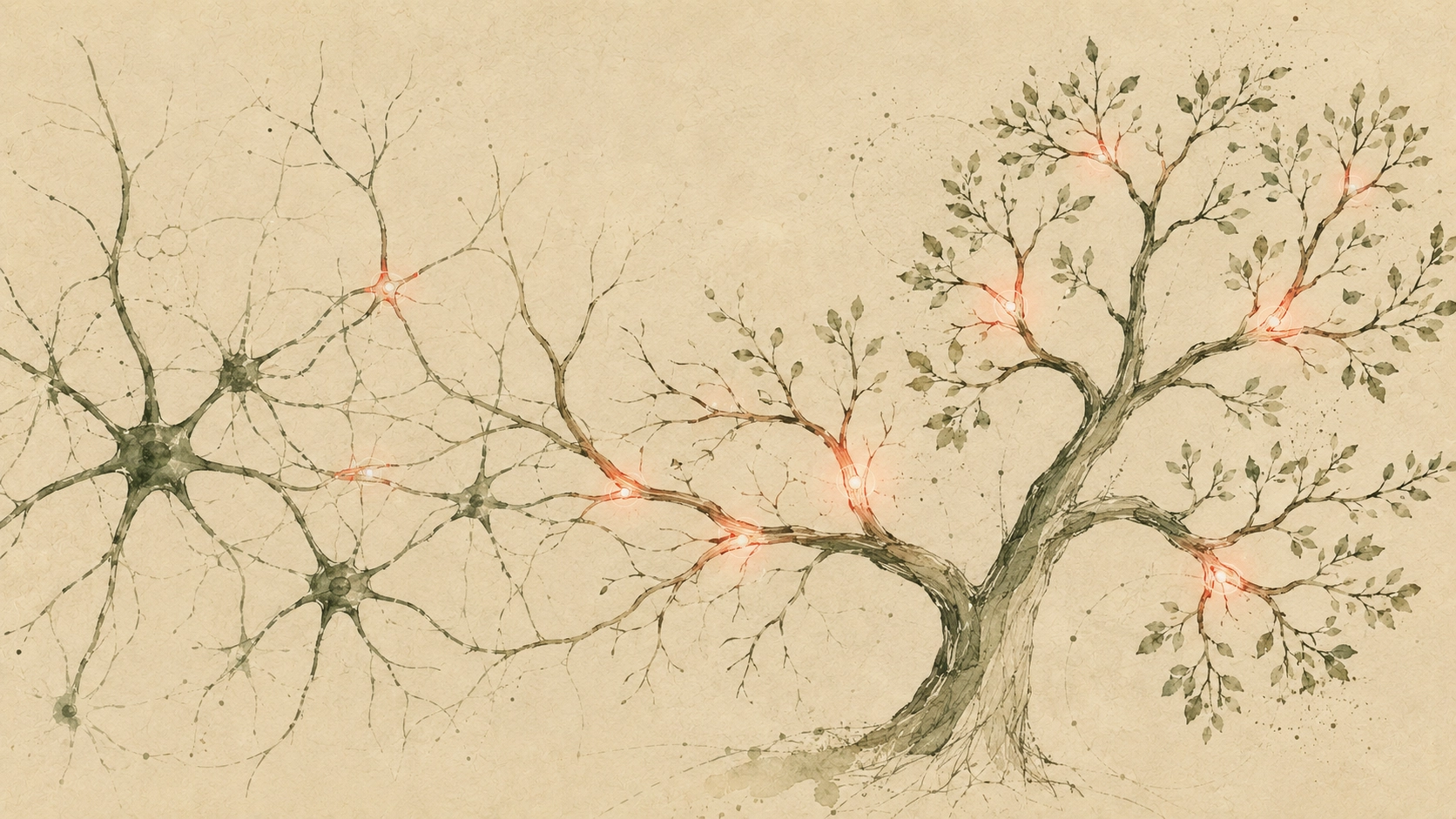
Neuroplasticity is the ability of the nervous system to adapt. Brain cells form new connections, existing networks strengthen or weaken, and behavioral patterns can change through experience, attention, and repetition.
This happens continuously:
- when you learn something new
- when you unlearn a habit
- when you recover from stress or injury
- when you learn to respond differently to a trigger
Trauma leaves traces, but growth does too.
Research shows that trauma is associated with changes in areas such as the amygdala (alarm center), hippocampus (context and memory), and prefrontal cortex (regulation, overview, decision-making). Chronic stress can dysregulate these systems, but focused treatment and safe new experiences can influence those networks again.
Why is this relevant in complex PTSD?#
In complex PTSD, it is often not about a single event, but prolonged or repeated unsafety. Think of childhood trauma, abuse, neglect, war, captivity, or relational violence.
The brain then often learns:
- always stay alert
- do not trust people
- suppress feelings
- detect danger before safety
- prioritize survival over living
These are not character flaws. They are deeply ingrained survival pathways.
Neuroplasticity means that new pathways can emerge. Not by erasing the past, but by building new roads alongside old ones.
A trigger may not disappear completely. But it no longer has to remain in control.
And what is moral injury?#
Moral injury occurs when someone is deeply wounded in their moral compass. For example by:
- doing something that goes against personal values
- failing to act when intervention seemed necessary
- betrayal by leaders or institutions
- witnessing human suffering without being able to act
- guilt, shame, or loss of meaning
Moral injury can resemble PTSD, but the core is often different. Where PTSD revolves largely around fear and threat, moral injury more often revolves around guilt, shame, alienation, and existential pain.
People say things like:
“I am no longer who I was.”
“I no longer trust myself.”
“I lost something that will never return.”
That is why moral injury requires not only stress regulation, but also restoration of meaning, truth, connection, and inner dignity.
New connections arise through experience, not theory alone#
Many people already understand rationally what is happening. Yet little changes. Why? Because trauma often does not live only in thoughts, but in automatic nervous system responses, body patterns, and reflexive interpretations.
The brain primarily learns through experience.
Not only:
- “I am safe.”
But experiencing:
- someone remains calm while you are tense
- you say no and the world does not collapse
- you feel tension and stay present
- you make a mistake and are not rejected
- you remember something old without becoming overwhelmed
These are small events. But neurologically, they can be enormous.
Recovery often lives in repeated, carefully dosed corrective experiences.
Gurdjieff’s Fourth Way: waking up in ordinary life#
Gurdjieff described human beings as largely mechanical: we react automatically, sleepwalk through life, and call that “I.”
His Fourth Way was not a monastic path and not a withdrawal from the world. Consciousness had to be practiced precisely in ordinary life.
That connects strikingly with trauma recovery.
1. Self-observation without judgment#
Gurdjieff emphasized observing yourself without immediately correcting or condemning.
In trauma, that may sound like:
- “My shoulders are tightening.”
- “I am scanning the room.”
- “I am people-pleasing.”
- “I am dissociating right now.”
The moment something is seen, space arises between impulse and reaction.
That is neuroplasticity in practice: attention interrupts automatism.
2. Multiple ‘selves’#
According to Gurdjieff, a human being consists of many temporary “selves”: the frightened self, the angry self, the exhausted self, the strong self.
For people with complex PTSD, this often feels familiar. You do not feel like one unified whole. Instead of seeing that as defectiveness, you can begin to understand that different parts tried to provide protection.
Then the question shifts from: what is wrong with me?
to: which part is trying to protect me right now?
3. Conscious effort#
Not forcing, but voluntarily doing something new while the old pattern pulls at you.
For example:
- still breathing calmly
- still maintaining contact
- still setting boundaries
- still remaining present without fleeing internally
These are forms of inner strength training.
Parallels in other mystical traditions#
Buddhism: not believing everything that appears#
Buddhism teaches mindfulness: thoughts, emotions, and sensations arise and pass away.
That helps with triggers. A wave of fear feels absolute, but it is not identical to truth.
Not: “I am lost.”
But: “There is currently an experience of loss.”
That subtle shift can be liberating.
Christian contemplation: silence as a holding space#
Christian contemplation knows the practice of resting in silence, prayer, and presence. Not everything has to be solved in order to be carried.
For moral injury, that can matter deeply. Where words fail, silent presence can sometimes heal more than analysis.
Sufism: polishing the heart#
Sufism speaks of the heart becoming covered over and needing to be polished again. Even after guilt or rupture, the core is not destroyed — only obscured.
That image helps many people more than clinical language does.
But let us stay grounded: no miracle cure#
Neuroplasticity does not mean:
- that trauma can simply be “trained away”
- that everyone heals at the same pace
- that willpower alone is enough
- that you have failed if triggers remain
Recovery depends strongly on circumstances:
Safety#
As long as someone still lives in danger, the brain remains rightly vigilant.
Relationships#
One regulating human connection can do more than a thousand insights.
Dosage#
Working too hard on trauma can become overwhelming. Too little challenge keeps patterns frozen.
The body#
Sleep, nutrition, movement, and stress load influence learning capacity.
Professional support#
Trauma therapies such as EMDR, exposure therapy, somatic therapy, IFS, ACT, or other fitting forms of guidance can help strengthen new neural networks.
Practical guidance: how do you begin building new pathways?#
1. Name patterns precisely#
Not: “I am broken.”
But: “I withdraw whenever someone gets close.”
What can be seen concretely can become changeable.
2. Work small and repeatable#
No heroic act is required. Responding one percent differently is already training.
3. Regulate first, analyze later#
Under high stress, the brain learns poorly. First settle. Then explore.
4. Seek reliable people#
Recovery often grows between people, not only inside your head.
5. Rebuild meaning#
With moral injury, the question is not only: how do I become calmer?
But also: what do I want to stand for now?
6. Practice presence#
Three conscious minutes a day of breathing, sensing, and observing may seem small. Added together, it becomes attention training.
Other publications and books worth reading#
Scientific publications#
- López-López et al. (2025). Neuroplasticity in Post-Traumatic Stress Disorder
- Deppermann et al. (2014). Stress-induced neuroplasticity: (mal)adaptation to adverse
- Babu et al. (2025). Physical and Emotional Interventions in Modulating Neuroplasticity
Books#
- Van der Kolk, B. (2014). The Body Keeps the Score
- Peter A. Levine Waking the Tiger
- Peter A. Levine In an Unspoken Voice
- Judith Lewis Herman Trauma and Recovery
- Judith Lewis Herman The Aftermath of Violence — From Domestic Abuse to Political Terror
- Ouspensky, P. D. In Search of the Miraculous — Fragments of an Unknown Teaching
- Frankl, Viktor E. Man’s Search for Meaning
Conclusion: the past remains, but it no longer has to rule#
Trauma shapes the brain. That is true. But experience shapes the brain too. That is also true.
Neuroplasticity offers no magic, but it does offer direction. Old reactions can soften. New choices can grow stronger. Triggers can become background noise instead of commands.
Perhaps recovery is not returning to who you once were.
Perhaps it is waking up to who you can now become.
Questions?#
Do you recognize this in yourself or in your work with others? Use the contact form to get in touch.