

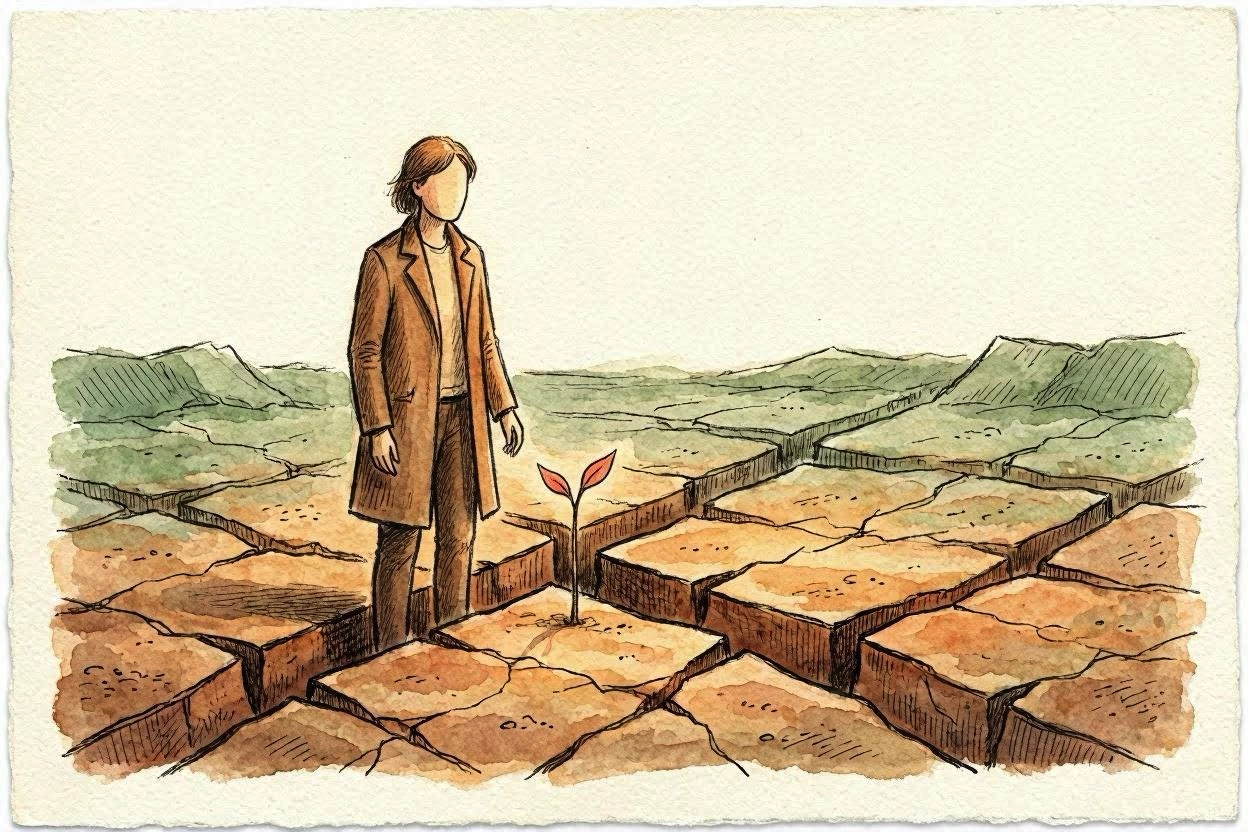
Not every scar closes. And yet something can grow.#
Some events break a person open. Loss, violence, betrayal, war, abuse, an accident, illness or moral rupture. They leave not only memories, but change the way you see yourself, others and life.
Yet after such a period, some people describe something remarkable. Not that it was good. Not that they are glad about what happened. But that in certain respects something changed — more depth, different priorities, greater honesty, more compassion or a stronger sense of direction.
In psychology, this is called post-traumatic growth.
That concept calls for care. Growth is not a compulsory destination. Trauma is not a hidden blessing. And pain does not dissolve automatically through insight. But sometimes, amid the wreckage, a different kind of life begins to take shape.
What is post-traumatic growth?#
The term Posttraumatic Growth (PTG) was brought to wider attention through the work of Richard Tedeschi and Lawrence Calhoun. They described positive psychological change that can emerge through the struggle following a significant event.
Importantly: the growth does not come from the trauma itself, but from what a person does in its aftermath — processing, finding meaning, revising choices, learning to live again.
Post-traumatic growth is not the same as resilience. Resilience means bouncing back to how you were. Growth goes further: a person changes in ways that were not present before the trauma.
Five forms of growth that are commonly recognised#
1. Greater appreciation for life#
Ordinary things carry more weight. Morning silence. A conversation without hurry. Baking bread. Wind on water. What once seemed self-evident now feels like something worth pausing for.
2. Deeper relationships#
People sometimes become more honest, more selective and more vulnerable in connection. Superficial contacts are set aside; genuine closeness is sought and valued more.
3. A sense of personal strength#
Not toughness, but the realisation: I can carry what I never wanted to carry. Those who have endured something that seemed unbearable sometimes discover a different relationship with themselves.
4. New possibilities#
Different work. Different choices. A new rhythm. A calling that was previously hidden. Sometimes trauma forces a reorientation that ultimately brings a person closer to their own life.
5. Spiritual or existential deepening#
More attention to truth, mortality, presence and what truly matters. Questions that were once theoretical or philosophical become personal and urgent.
Growth does not take the pain away#
This is where popular language often goes wrong — as though growth means the wound has closed. As though insights resolve nightmares. As though meaning neutralises the damage.
That is usually not how it works.
A person can grow and grieve at the same time. Become wiser and still be dysregulated. Develop more compassion and still experience triggers. Post-traumatic growth and PTSD symptoms can coexist; they do not exclude each other.
Sometimes surviving is already enough. Sometimes stabilising is the gain. Sometimes a day without being overwhelmed is pure progress.
What does research say?#
Research into post-traumatic growth presents a nuanced picture. There are recognisable patterns, but also serious caveats that honesty requires.
What research supports#
Social support helps. People who experience support from safe others more often report growth. Not because support erases trauma, but because recovery becomes easier in connection.
Reflection and meaning-making help. Those who find words for what has happened can gradually order inner chaos. Writing, talking, therapy — all these forms of processing contribute.
Growth and symptoms can coexist. A person can retain PTSD symptoms and at the same time have changed in priorities, relationships or outlook on life.
What research qualifies#
Not every reported instance of growth is lasting or genuine. Sometimes what a person describes as growth is a protective narrative — a way of making the pain bearable. That is understandable, but it is something different from actual change in behaviour and choices.
Moreover, post-traumatic growth is difficult to measure objectively. Most studies rely on self-report, and people tend to emphasise positive change, even when it is minimal. Genuine growth only becomes apparent later, in how a person actually lives — not only in what they say about it.
Shame, compassion and recovery#
Trauma is often accompanied by shame: the feeling that something is wrong with you, that you should have responded differently, that you brought it on yourself.
Precisely there lies an important key.
The work of Brené Brown on vulnerability and Paul Gilbert on Compassion Focused Therapy points in the same direction: recovery deepens when inner condemnation softens. Not by suppressing the critical voice, but by placing another voice beside it — one that acknowledges what was difficult, without judging it.
Compassion is not a soft luxury. It is a different way of being with yourself: not believing everything your inner prosecutor says, and not abandoning yourself when pain becomes felt.
The Fourth Way of Gurdjieff: working in ordinary life#
The Fourth Way of Gurdjieff is a spiritual and psychological tradition that places conscious self-work at its centre — not in seclusion or under ideal circumstances, but in the midst of everyday life.
The connection with post-traumatic growth is concrete. Someone who, after trauma, learns to remain present with themselves instead of fleeing into thought or paralysis is practising self-remembering in Gurdjieff’s sense. Someone who does not allow themselves to be imprisoned by fear or shame — who recognises that they are more than their past — is practising what the tradition calls non-identification.
Some connections:
- Self-remembering — staying present with yourself, even when it is difficult
- Non-identification — you are more than your fear or your past
- Conscious effort — taking small, honest steps without self-deception
- Working with head, heart and body — growth requires the whole person
The Fourth Way adds a sober layer: do not wait for perfect circumstances. Work with what presents itself today.
What does growth look like in real life?#
Not always spectacular. Often small and quiet.
Someone who learns to set boundaries where that once seemed impossible. Someone who dares to ask for help for the first time in years. Someone who stops pleasing others and notices that relationships become more genuine as a result.
Sometimes post-traumatic growth means: valuing rest over status, and noticing that this is not a loss but a liberation. Or speaking more honestly, even when that is uncomfortable. Or becoming gentler with yourself — not as weakness, but as a choice.
Sometimes it is more concrete: choosing different work, living more in accordance with your own values, being able to enjoy ordinary things again that once seemed self-evident.
What helps make growth possible?#
1. Safety first#
Without basic safety, deepening quickly becomes too much. Regulation comes before reflection.
2. Relationships that hold#
Therapy, friendship, peers or a wise guide can make a great difference. Growth rarely happens alone.
3. Practising small moments of presence#
One conscious breath. Feeling your feet. Briefly noticing what is here right now. Not as a technique, but as practice in being allowed to exist.
4. Making room for grief#
What has been lost deserves space. Growth does not begin with acceptance, but with recognition of what truly is.
5. Respecting timing#
Growth cannot be forced. Seasons have their own rhythm, and the same is true for recovery.
Relevant also for moral injury#
In moral injury, guilt, shame, loss of trust and existential rupture are often central. A person has done, witnessed or been unable to prevent something that conflicts with their deepest values.
Post-traumatic growth can be possible here too — not by making the past seem better, but by:
- looking truth in the eye without drowning in it
- distinguishing responsibility from unwarranted guilt
- re-evaluating values based on what has been learned
- rediscovering humanity, including in one’s own fallibility
- choosing again how you want to live
Read also#
- What is the difference between PTSD and moral injury?
- Trauma and the body
- Silence and PTSD
- The power of language
- Systemic work in trauma
- Francis of Assisi — mysticism as a human path of recovery
Conclusion#
Post-traumatic growth is not a happy ending and not an obligation. It is the possibility that a person, after disruption, becomes more genuine, more mature and more conscious in certain respects — while the pain may remain, the loss may remain, and scars may stay visible.
Growth does not mean leaving the trauma behind. It means bringing something new from what you have been through: more honesty, more compassion, a sharper sense of what truly matters.
Perhaps that is the essence: not becoming greater than the past, but living more authentically than before the rupture.