

Sometimes you know exactly what would be wise, but you cannot feel it. Sometimes you feel everything, but cannot think clearly. And sometimes you just keep going while your body has already slammed on the brakes. Many people recognize that inner division. As if different parts inside them are no longer working together.
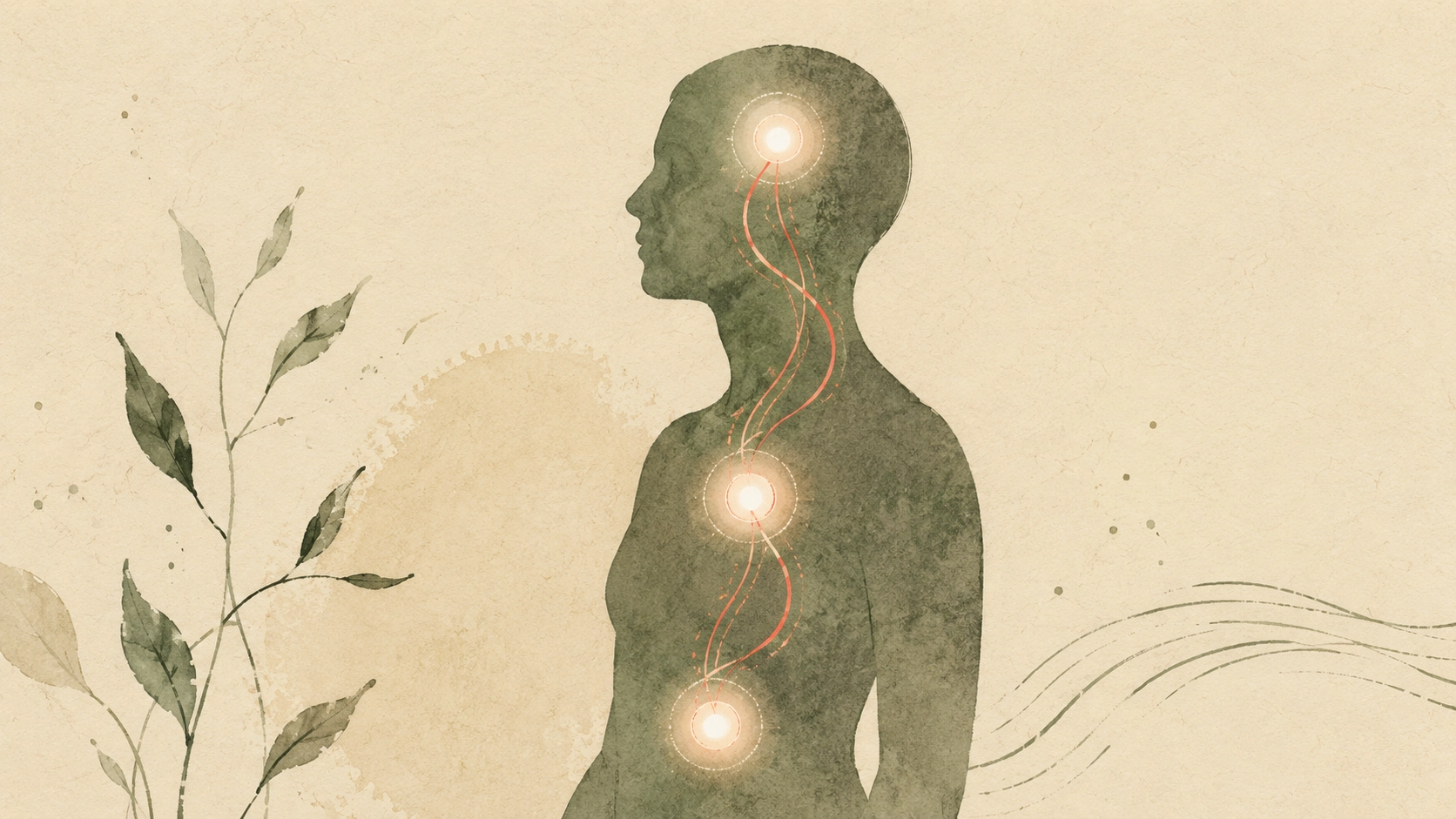
An old but surprisingly practical model describes this as three centers: head, heart, and gut. Not literally three brains, but three forms of intelligence. Thinking, feeling, and acting. When they work together, there is direction. When they fall out of balance, confusion, stress, and inner conflict emerge.
Introduction#
In modern language we speak about cognition, emotional regulation, and the nervous system. Older traditions spoke about head, heart, and gut. The words differ, but the experience is recognizable.
G.I. Gurdjieff worked with this threefold model in his Fourth Way. Not as a belief system, but as a practical compass for self-knowledge. This model can also help in PTSD, CPTSD, and moral injury. Trauma often fragments what once worked together. Head, heart, and body lose connection with each other.
Recovery then requires more than symptom management. It requires integration.
What are head, heart, and gut?#
Not literally three separate brains, but three forms of intelligence, each with its own pace, language, and function. Below are the three centers, along with their strengths and pitfalls.
The head#
The head represents thinking, analysis, planning, language, and overview. It helps us solve problems and make decisions — its strengths are insight, structure, discernment, and reflection. Under stress, however, it can tip into overthinking, rumination, seeking control, and disconnecting from feelings.
Many people with trauma end up living in their head for a long time. Thinking feels safer than feeling.
The heart#
The heart represents emotion, connection, empathy, beauty, and moral awareness. This is where we experience love, grief, joy, and emotional impact. Its strengths lie in connection, compassion, meaning, and relational wisdom. When dysregulated, the same center can tip into emotional overwhelm, shame and guilt, emotional dependency, or shutting down so completely that nothing is felt anymore.
In moral injury, this center is often deeply wounded.
The gut#
The gut represents instinct, action, rhythm, boundaries, and bodily intelligence. Think of intuitive reactions, movement, taking action, and sensing tension before you can explain it. Its strengths are grounding, action, perseverance, healthy boundaries, and body awareness. In trauma, the same center tips the other way — into fight, flight, freeze, numbing, or chronic tension.
This is often where the autonomic nervous system runs at full speed.
Why this model helps in PTSD#
Trauma rarely affects just one layer. It impacts thoughts, emotions, and the body.
It can look like this. A dysregulated head shows up as repetitive thoughts, flashbacks, catastrophic thinking, and constant vigilance. A dysregulated heart shows up as shame, guilt, emptiness, emotional detachment, and difficulty trusting others. A dysregulated gut shows up as exaggerated startle responses, tense breathing, insomnia, restlessness, and exhaustion.
When you work only with thoughts, the body often lags behind. When you focus only on feelings, direction can get lost. This model helps widen the perspective.
Not three brains, but three entry points#
Strictly speaking, biology does not support the idea of three separate brains in the way popular culture sometimes suggests. It is better understood as a working model.
What science does show is that thinking, emotion, and the body are deeply interconnected:
- embodied cognition shows that thinking is connected to the body
- neurocardiology studies communication between heart and brain
- the enteric nervous system influences mood and stress
- polyvagal theory emphasizes the role of safety in behavior and connection
Ancient wisdom and modern science overlap more often than people think.
Current research: body and brain function as one system#
Recent research directions, including work at the University of Amsterdam, no longer focus on separate “brains,” but on the interaction between multiple systems. Examples include the gut-brain axis, heart rate regulation, interoception, and the influence of the immune system on mood and stress.
In other words: your gut does not “think” the way your head thinks, but signals from the gut, heart, and nervous system absolutely influence how you feel, react, and make decisions.
The language of head, heart, and gut remains useful as a human model. Science describes the same reality more precisely as a network of mutual regulation between brain, body, and environment.
Gurdjieff and the Fourth Way#
Gurdjieff argued that people often live mechanically: automatically reacting from habit, fear, or conditioning. Many trauma responses feel exactly like that. You know what you want, yet an old pattern takes over.
His invitation was not to become perfect, but to become more awake. More present to what is happening without being completely consumed by it.
That makes his work surprisingly relevant today.
How do you recognize where you are?#
During stressful moments, ask yourself:
Am I in my head?#
I analyze everything, but feel very little.
Am I in my heart?#
I feel a lot, but lose direction.
Am I in my gut?#
I react immediately, without overview.
Even asking the question can already create some space.
Practical exercises for balance#
1. The three-minute check-in#
Minute 1 – Head#
What thoughts are circling right now?
Minute 2 – Heart#
What am I actually feeling underneath the surface?
Minute 3 – Gut#
What does my body need right now?
For example: rest, movement, food, boundaries, or breathing space.
2. From head back to body#
When you keep spiraling in thought, look around the room. Feel your feet on the ground. Lengthen your exhale. Name five things you can see.
3. From overwhelm back to direction#
When emotions take over, place a hand on your chest. Name what you feel in one word. Choose one small next step.
4. From impulse to conscious action#
When you want to react immediately, pause for ten seconds. Exhale. Notice your jaw and shoulders. Then choose your response.
Why this also helps with moral injury#
Moral injury is often about conscience, values, and identity. People feel internally divided. The head may understand the context, but the heart still carries pain. The body remains alert or withdraws completely.
In that case, recovery is not only about calming down, but also about reconnecting with what feels true and worthy.
The goal is not perfect balance#
Nobody lives in constant harmony. Nor is that necessary. The goal is not to always be calm, wise, and centered.
The goal is to recognize more quickly what is happening and to learn how to adjust with more kindness toward yourself.
That alone is already a lot.
Further reading#
- Breathing and PTSD
- Grief in PTSD and Moral Injury
- The Body Keeps Trauma
- The Difference Between PTSD and Moral Injury
- Daily Rhythm and PTSD
Sources and literature#
- Gurdjieff, G.I. Beelzebub’s Tales to His Grandson.
- Ouspensky, P.D. In Search of the Miraculous.
- Wilson, M. (2002). Six Views of Embodied Cognition.
- Porges, S. The Polyvagal Theory.
- Damasio, A. The Feeling of What Happens.
- McCraty, R. publications on heart-brain interaction.
Conclusion#
A lot of inner conflict does not arise because something is wrong with you, but because different parts within you are asking for attention. The head wants to understand. The heart wants to feel. The gut wants safety and direction.
When those three begin to reconnect, something returns that many people have lost: coherence.
Maybe that is what recovery often really is. Not becoming someone else, but feeling like one human being again.
Questions?#
Do you recognize this in yourself or in your work with others? Feel free to reach out through the contact form.