

Some reactions do not feel entirely like your own. A fear response far larger than the situation calls for. Shame without a clear source. Loyalty to something you never personally experienced. In PTSD and moral injury, there is sometimes something older than your own biography at work: experiences from previous generations continuing through your body, behavior, and relationships.
In this post, I place three lenses side by side on that phenomenon: the epigenetics of Rachel Yehuda and Mark Wolynn, the systemic work of Bert Hellinger, and the “many selves” from Gurdjieff’s Fourth Way. Three different languages for the same observation: a human being is not only themselves, but also a carrier of a lineage.
A Question That Forces Itself Forward#
Anyone who lives with PTSD or moral injury for a long time eventually encounters the question: why does this feel so heavy? Not only because of what you personally experienced, but deeper than that. As if more is living inside you than your own history can explain.
For people in professions exposed to trauma — police officers, military personnel, emergency workers — this question often carries extra weight. They do not only carry what they themselves have seen, but often something from a family line in which war, violence, illness, or loss already played a major role.
What Wolynn Brings Forward: Trauma Is Inherited Too#
In It Didn’t Start With You (2016), Mark Wolynn lays out the scientific foundation behind this idea. He relies heavily on the work of Rachel Yehuda, an American researcher who spent years studying Holocaust survivors and their children.
Yehuda and her colleagues found something striking: children of Holocaust survivors showed chemical markers on a specific gene, FKBP5, involved in the stress response. Similar markers were found in their parents. Trauma had not only been told — it had been imprinted (see Intergenerational Effects on FKBP5 Methylation).
This phenomenon is called epigenetics: the DNA sequence itself does not change, but the way genes are expressed can shift under the influence of experience. And some of those patterns can partly be passed on.
Wolynn translates this into accessible language and connects it to a simple guiding question: look within your family for the event that matches the emotional tone of your own symptoms. An unexplained fear of suffocation? Perhaps a grandparent once hid in a cellar. Persistent shame? Perhaps a father experienced something and never spoke about it.
The idea is not that everything can be traced back neatly. The idea is that some reactions only begin to make sense when viewed within a family line instead of as a personal defect.
What Hellinger Added: Systemic Work#
Long before Wolynn wrote about this, Bert Hellinger (1925–2019), a German former priest and psychotherapist, developed a method for exploring this terrain: the family constellation. In a group setting, someone symbolically places the loss, guilt, or exclusion of an ancestor into the room. Other participants represent family members. Through careful observation and subtle movements, the facilitator attempts to make visible what has become blocked within the system.
Hellinger’s theoretical framework rests on several core ideas:
- The orders of love — every family system has an order (who belongs, who came first, who was excluded). Disturbance of that order creates symptoms in later generations.
- Loyalty — descendants unconsciously carry pain, guilt, or illness out of love for an ancestor.
- Entanglement (Verstrickung) — someone entangled in another person’s fate cannot fully live their own life.
- Acknowledging what is — healing begins not with changing reality, but with recognizing it: seeing what happened without judgment and without immediately trying to fix it. Here Hellinger touches an older wisdom also found in other traditions.
I will return later to the controversies surrounding Hellinger. But his observation that a person can carry what was previously unmourned, unacknowledged, or unseen has resonated deeply with many practitioners.
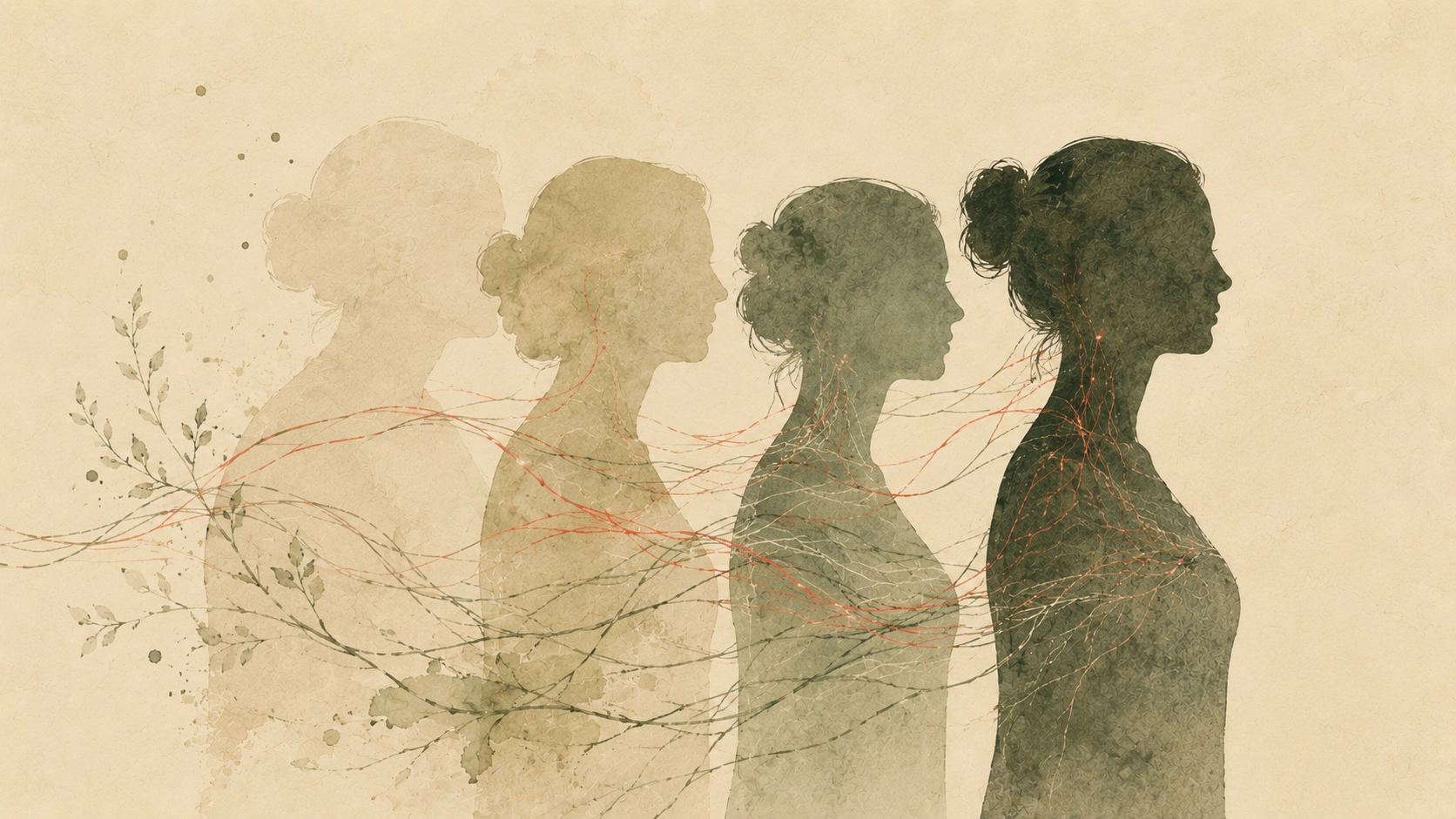
Three Lenses on One Phenomenon#
What stands out is that epigenetics, systemic work, and trauma dissociation research all point toward the same underlying pattern. A human being is not one sealed-off entity, but a collection of parts, lines, and layers that do not all originate from themselves.
- Epigenetics (Yehuda, Wolynn) calls this an inherited imprint: biological. A gene expressed differently because of what an ancestor experienced.
- Systemic work (Hellinger) calls this entanglement: relational. A pattern attaching itself to a role or position within the system.
- Trauma research (Van der Hart et al.) calls this structural dissociation: psychological. Parts of the personality living separately because coexistence became impossible. See The Haunted Self.
- The Fourth Way (Gurdjieff) calls this the many selves: philosophical. A shifting group of inner voices that do not all want the same thing.
Four words, four explanations, one observation: you are not simply one.
The Bridge to Moral Injury#
For moral injury, this phenomenon is especially relevant. Moral injury concerns acting against one’s own values or witnessing actions that violate them. The resulting pain — guilt, shame, loss of meaning — often cannot be traced back to a single moment.
A police officer or soldier who has gone through a morally devastating experience may discover that it resonates with something older. A grandfather who acted against his conscience during war. A family member whose story was never told. The present experience is then not the only source of pain; it reopens a line.
That does not remove personal responsibility. What it does is reveal that moral pain sometimes carries more than one person’s conscience alone can bear. Healing then becomes not only personal work, but also work for a lineage. The grieving process around moral injury gains another layer: mourning not only what happened to you, but also what remained unresolved before you.
The Bridge to the Fourth Way#
In The Fourth Way, I described the many selves as shifting voices within a person. Wolynn and Hellinger add another dimension: some of those voices are not entirely your own. They are voices from before. A self that wakes up exhausted in the morning may reflect your own fatigue — or the exhaustion of a grandmother who never rested.
Gurdjieff asked people to observe these selves rather than fight them. Hellinger asked people to acknowledge their ancestors rather than ignore them. Wolynn asks us to understand the sentence from which a pattern originated. In essence, they ask for the same thing: stop fighting what lives inside you, and give it its proper place. Only then can something new emerge.
For people doing trauma work — or living through trauma themselves — this perspective can offer hope. It does not remove effort or responsibility. But it reminds you that you are not working alone; you are working within a line that began before you.
What Systemic Work Is Not#
For balance, and just as with the Fourth Way, some honest caveats are necessary.
- It is not a scientifically proven method. Epigenetics itself is evidence-based, but the practical applications of Wolynn and Hellinger sometimes go beyond what current research strictly supports. Evidence for family constellations as therapy remains limited.
- Hellinger remains controversial. Some of his statements regarding abuse victims, Holocaust survivors, and gender issues have been rightly criticized. Anyone exploring systemic work should remain critical and never place authority above common sense.
- Family constellations are not for everyone. For people with PTSD, complex trauma, or structural dissociation, constellation work can be triggering. Only do this under guidance from a trained, trauma-aware facilitator, ideally alongside an ongoing therapeutic relationship.
- It is not a replacement for therapy. Insight into patterns is different from processing trauma. Both matter.
- Not everything is transgenerational. The temptation to trace every symptom back to an ancestor is understandable but incorrect. Most things are simply yours. Sometimes something is older. Learning to distinguish the difference is the real skill.
Practical Reflections for Readers#
No exercises for doing constellations alone — for that, I recommend trained facilitators. But there are a few reflections you can safely explore yourself.
- Look at the pattern, not only the content. Which emotions return disproportionately often? Which reactions feel “larger” than they should?
- Ask about unresolved family stories. Not to judge, but to know. War, loss, displacement, secrets, exclusion — all are possible carriers of transgenerational impact.
- Exclude no one. In Hellinger’s work, the question of “who belongs” is central. An excluded family member (a stillborn child, a denied relationship, a black sheep) can reappear in later generations asking for acknowledgment.
- Read Wolynn before reading Hellinger. Wolynn is more contemporary, more cautious in tone, and explicitly grounded in research.
- Discuss it with your therapist. Especially if you are already in trauma therapy. Some therapeutic approaches align well with systemic thinking, others less so. Good coordination prevents confusion.
Frequently Asked Questions#
Is transgenerational trauma scientifically proven?#
Partly. Epigenetic mechanisms involving stress and cortisol regulation have been demonstrated in animals and in human populations such as Holocaust survivors and their children. How precisely this translates into individual symptoms remains under investigation. The concept is scientifically plausible; the interpretation in blogs or constellation work remains interpretation, not proof.
Do I have to believe in constellations to find Wolynn useful?#
No. Wolynn’s method — focusing on the “core language” of symptoms and family patterns — can be explored without ever attending a constellation session. Epigenetics stands independently from Hellinger’s work.
Can this help with moral injury?#
Sometimes. Moral injury often has a moral dimension that resonates with family lines, especially in professions repeatedly confronted with moral dilemmas across generations. Research consistently highlights meaning, community, and acknowledgment as important factors in recovery; systemic thinking fits naturally into that framework. But again: it is complementary, not a replacement.
What if my family cannot or will not talk about the past?#
That is very common. Many families carry silence or secrets. Wolynn describes how even fragments can matter: one name, one photograph, one suspicion. A skilled professional can sometimes help uncover meaning from very little information.
How is this different from IFS (Internal Family Systems)?#
IFS works with internal “parts” within a person: managers, firefighters, exiles. Systemic work places those parts within a broader family system and looks at lineage and origin. In practice, the approaches often complement one another well.
Conclusion#
Not everything is yours alone. Some reactions carry the weight of a lineage. Acknowledging that is neither an excuse nor an escape. It is the opposite: seeing where you stand, which current you are part of, what you have received, and what you pass forward.
For people living with PTSD or moral injury, this perspective can bring relief. The burden becomes slightly less lonely when you suspect it may not belong only to you. And the effort itself takes on another meaning: you are not working only for yourself. You are working for what you received in love, and for what you now transform in the direction of those who come after you.
That is where it begins.
Further Reading#
- The Fourth Way — about the “many selves” as a life practice
- Difference Between PTSD, CPTSD, and Moral Injury — for the core concepts
- Post-Traumatic Growth — about what can become possible after processing trauma
Questions?#
Do you recognize this in yourself or in your work with others? Use the contact form to get in touch with me.