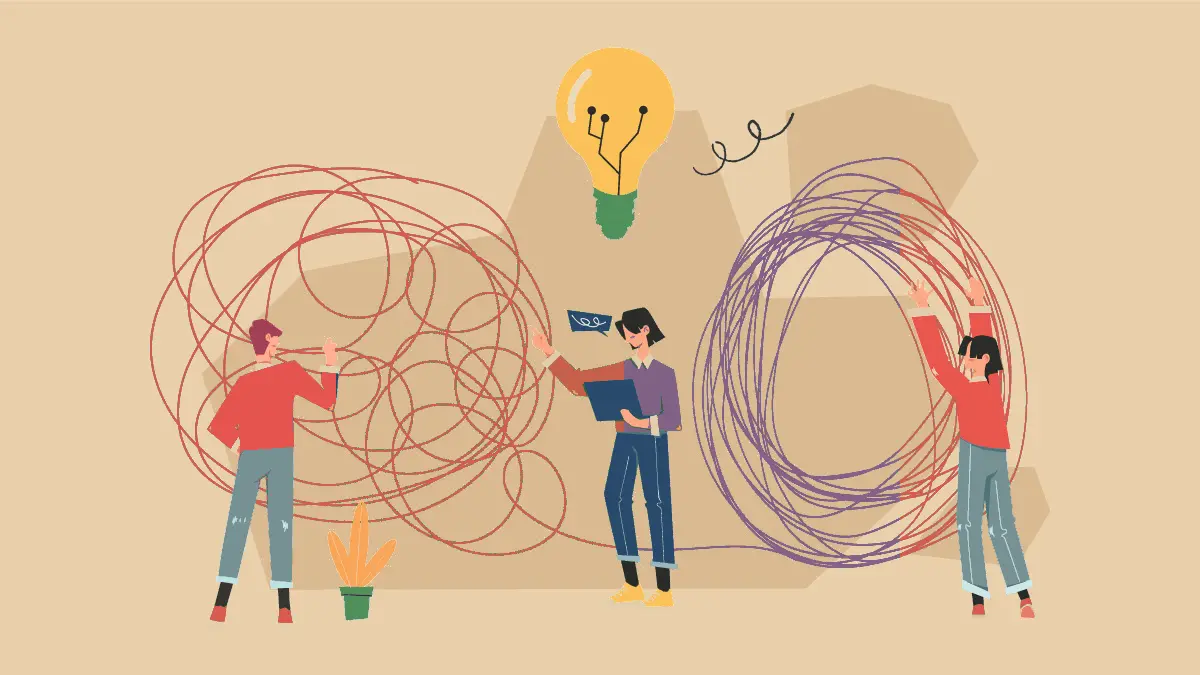
If you have a problem in your world, the problem has already been solved in another world.
This article was not written out of academic interest. It was written because that sentence turned out to be true. Even for the most personal problems people know.
This is not a therapy guide. It does not replace professional support. It is an attempt to place three systems side by side that each, in their own way, describe the structure of a human impasse — and each, in their own way, point to a way out that is not a compromise.
This article goes deeper.
Part I — Altshuller in the Gulag: the beginning of TRIZ
A letter to Stalin
In 1950, a young Soviet engineer wrote a letter to Joseph Stalin.
The letter was not a petition. Not a plea. It was an indictment.
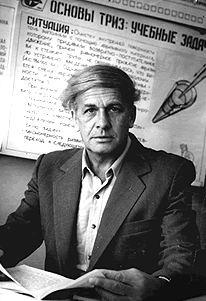 Genrich Saulovich Altshuller, born in 1926, worked as a patent examiner for the Soviet navy on the Caspian Sea. In that role he analysed hundreds of inventions and began to see something no one else saw. Most so-called innovations were not real breakthroughs. They were adjustments. Compromises. Variations on existing solutions.
Real inventions, he wrote to Stalin, followed a different pattern. They broke through a fundamental contradiction. They solved a problem that had previously seemed unsolvable — not by working around it, but by changing the structure of the problem itself.
And the Soviet Union, he went on, was doing this systematically wrong.
He was arrested.
The charge: activities against the state. The sentence: 25 years in a Gulag camp in Siberia.
He was 24 years old.
What happened in prison
In the Gulag, Altshuller had almost no paper. Almost no rest. Almost no protection against the bitter cold and the arbitrariness of guards.
What he did have was his mind.
And in that mind, he kept working.
Not as distraction. Not as survival in the sense of forgetting. He kept thinking about the problem that had occupied him before his arrest: what is the structure of a real invention?
This in itself is remarkable. A man in extreme deprivation, in conditions designed to break the mind, chooses to direct his mind toward an abstract intellectual question.
But there is more.
Altshuller's situation shows features that today would be associated with Moral Injury. He had done something he considered right: speaking the truth about a system that was wrong. And he was punished for it in a way that violated every sense of justice.
The world no longer added up.
His response was not an adaptation to that world. It was a deepening of his own thinking.
A man who cannot change his surroundings can change the way he looks. Altshuller chose the latter — not as escape, but as an act.
After Stalin: the method
In 1953, Stalin died. Altshuller was released and rehabilitated.
He returned to his work, but now with years of uninterrupted thinking behind him.
What followed was a life devoted to working out what he called TRIZ: Teoriya Resheniya Izobretatelskikh Zadach — the Theory of Inventive Problem Solving.
He eventually analysed more than 400,000 patents from dozens of fields, described in his book And Suddenly the Inventor Appeared. His conclusion was as simple as it was radical:
Inventors do not solve unique problems. They recognise universal patterns of contradiction and apply universal patterns of breakthrough.
The method he developed — laid out in Creativity as an Exact Science — consists of several layers: the 40 inventive principles, the contradiction matrix, the understanding of physical, technical and administrative contradictions, and the concept of the Ideal Final Result.
But the core — the philosophical core — is this:
A real solution is not a compromise between two incompatible demands. It is a breakthrough that removes the contradiction itself.
Part II — The structure of contradiction
What TRIZ means by a contradiction
The word 'problem' is misleading.
A problem suggests there is a solution we simply haven't found yet. Search harder, think smarter, and you'll find it.
But many of the most difficult problems, technical and human alike, are not problems in that sense. They are contradictions.
A contradiction is a situation in which improving one parameter makes another parameter worse. Not from a lack of knowledge or creativity. But structurally. As a consequence of how the system is built.
A technical example: the Oukoper Mill
 The Oukoper Mill is a polder windmill in Nieuwer ter Aa, the Netherlands. A scoop-wheel mill, designed to pump water out of the polder.
At some point, more water needed to be pumped away. The obvious solution: make the scoop wheel bigger. More wheel, more water per revolution.
But a bigger wheel is heavier. A heavier wheel needs more force to turn. More force means more wear on the axle, more strain on the structure. What you gain in capacity, you lose in efficiency and durability.
The obvious solution creates a new problem.
The solution that was actually found was different. The blades of the existing wheel were curved.
Curved blades catch the water differently — they hold it longer per blade, converting the energy more efficiently. Power increased. The wheel did not get bigger or heavier. The structure remained unchanged.
In TRIZ terms: the technical contradiction was resolved with Principle 4 — Asymmetry. Not the scale that changed, but the geometry. The contradiction was removed, not solved.
This is the difference TRIZ makes: not finding a better balance between two conflicting demands, but finding a way out that lies outside the plane of the contradiction.
The 40 principles — and which ones lie closest to PTSD and Moral Injury
Altshuller formulated 40 inventive principles. Universal strategies that inventors throughout history have applied — often without knowing it.
Six of them describe something that people recovering from trauma often already do — or precisely cannot do. Not as technique. But as a movement that waits somewhere inside them.
Principle 1 — Segmentation
The feeling that everything comes at once. That the past is one large, indivisible weight.
TRIZ says: divide. Not carrying the whole, but this one part, at this one moment. Not 'my trauma' — but this memory, today, here. What is bearable becomes visible when you stop trying to lift everything at once.
Principle 10 — Prior Action
The urge to throw yourself in at the deep end. Or to avoid everything until it somehow resolves itself.
TRIZ says: prepare the ground before you try to stand on it. Establish safety first, then approach what is difficult. Not as postponement. As precondition. Someone who knows there is support when things become too heavy can go further than someone who does not.
Principle 13 — Inversion
The question that keeps returning: what is wrong with me?
TRIZ says: invert the question. Not what is wrong with you — but what your reaction tells you about what actually happened. The fear, the anger, the withdrawal: these are not defects. They are answers to something that deserved an answer. The diagnosis becomes a compass rather than a verdict.
Principle 22 — Turning Harm into Benefit
The pain that feels like proof that you are broken.
TRIZ says: turn it over. The sharp pain of moral violation is not proof that something is broken. It is proof that something is still intact. Someone who feels nothing in the face of injustice has lost their moral compass. Someone who still feels pain is still carrying it. That is not weakness. That is evidence of what still stands.
Principle 25 — Self-Service
The sense that recovery is something others do. That you are waiting for someone to repair you.
TRIZ says: the system that makes recovery possible already lives inside you. Not as cliché. As architecture. External help creates conditions — but the movement always comes from within. The step from passive recipient to active investigator of your own system is small. The consequences are not.
Principle 35 — Parameter Transformation
The thought you cannot reason away. The memory your mind knows how to place but your body does not.
TRIZ says: do not change the content — change the state. Not rewriting the memory, but setting the body that holds it in motion. Swimming. Walking. A mill wheel turning. Water that offers resistance and carries you at the same time. These are not incidental. They are direct interventions at the level where the pain lives.
The contradiction matrix links these principles to specific technical parameters. But the deepest value of TRIZ does not lie in the matrix itself — as Ilevbare, Probert and Phaal also show in their review of TRIZ in practice.
It lies in the way of looking that TRIZ requires: learn to formulate the contradiction exactly, before you go looking for a solution.
Part III — Gurdjieff and the Fourth Way
Three ways, and a fourth
George Ivanovich Gurdjieff was an Armenian-Greek teacher who, in the first half of the twentieth century, described a system of inner development that he called the Fourth Way.
The name refers to a distinction. The traditional paths of spiritual development:
- the way of the fakir (the body)
- the way of the monk (feeling)
- the way of the yogi (the mind)
Each of them requires withdrawal from ordinary life. Monastery, ashram, isolation.
The Fourth Way takes place within ordinary life. In work, in relationships, in daily activities. Not despite the complexity of life, but precisely through that complexity.
Mechanical life
The core of Gurdjieff's diagnosis is uncomfortable.
The average person, he argues, does not really live. He reacts. Automatically, mechanically, predictably. Thoughts arise without him choosing them. Emotions sweep through without him steering them. The body moves through habits he never consciously learned.
He calls this the sleep of man.
Not meant metaphorically. Gurdjieff believed, as Ouspensky describes at length in In Search of the Miraculous, that most people live in a state that functions like sleep: present to the outside world, absent to themselves.
People think they think. They don't. They repeat thoughts that were taught to them, in patterns that were never explained to them, in reaction to stimuli they never examined.
Self-observation and self-remembering
The first movement of the Fourth Way is self-observation.
Not therapy. Not analysis. Not improvement.
Just seeing.
What am I thinking right now? What am I feeling right now? What is my body doing right now?
This sounds simple. In practice it is one of the hardest exercises there is. Because the automatic patterns of thinking, feeling and reacting are so deeply ingrained that they have become invisible.
Gurdjieff added a second layer to this: self-remembering.
Not just observing what is going on inside you. But being present, at the same time, as the observer itself. Being aware of yourself while being aware of what is happening.
This double awareness — being present as subject and as object — is what Gurdjieff considered the beginning of real awakening.
The law of three
Here we touch the heart of the connection with TRIZ.
Gurdjieff described a fundamental law he called the law of three:
Every phenomenon in the universe, from a chemical reaction to a human conflict, is the result of the interplay between three forces:
- The affirming force: the active, driving force.
- The denying force: the resistance, the counterforce.
- The reconciling force: the third force that breaks the impasse.
Two forces alone produce no movement. They produce a stalemate. The third force is what sets the system in motion. This third force is almost always invisible to anyone who only looks at the first two.
Whoever tries to solve a problem by pushing harder against the resistance reinforces the impasse. Whoever learns to look at the structure of the situation discovers the third force that makes movement possible.
This is structural and follows a pattern comparable to what TRIZ describes.
TRIZ does not call it a law of three. TRIZ speaks of contradiction (opposition) and finding a solution at a higher level. But the movement is the same: stop fighting the counterforce. Look for the third possibility that lies outside the plane of the contradiction.
Three centres
A second key concept of the Fourth Way is the teaching of the three centres: the intellectual centre, the emotional centre, and the moving centre (the body).
Each centre has its own intelligence, its own pace, its own language. Most people function predominantly from one centre, are barely aware of the other two, and are not aware at all of the tension between the three.
Gurdjieff argued that real development requires the integration of all three. Not as an abstract ideal, but as a concrete, daily exercise.
Part IV — Moral Injury as contradiction
What Moral Injury is — and what it is not
Moral Injury is a concept first systematically described by Jonathan Shay in Achilles in Vietnam, his work on Vietnam veterans, and later further developed by researchers such as Brett Litz and Frank Frese.
The definition is precise: Moral Injury arises when someone experiences, does, or fails to prevent something that fundamentally violates their deepest moral convictions — and the system around them then fails to acknowledge that experience, brushes it aside, or actively denies it.
It is not the same as PTSD, although the two often occur together.
PTSD is now often understood as a condition in which dysregulation of the nervous system plays a central role. The body has learned that danger is always near, and keeps reacting as though that is still true — even when the objective danger has long since passed.
Moral Injury touches a different layer. Not safety, but meaning. Not the nervous system, but the moral foundation on which someone has built their identity.
Moral Injury is the experience that the world no longer adds up. That what should be is not. That what you did or failed to do can never be undone. That the books don't balance.
The deep contradiction of Moral Injury
Anyone who knows Moral Injury from the inside recognises a specific structure of pain.
It is not only grief. It is not only guilt. It is a persistent, unbearable tension between two realities that cannot exist at the same time — but are both true.
I did what I had to do. And what I did was wrong.
I trusted the system. And the system betrayed me.
I could have done it differently. And I could not have done it differently.
These are not psychological confusions that therapy can resolve. These are real contradictions — situations in which two opposing truths hold at the same time.
And here TRIZ appears in a way no one anticipated.
TRIZ states: a contradiction does not resolve itself by choosing one side. A contradiction resolves itself by finding a third perspective that lies outside the plane of the contradiction.
This is exactly what recovery from Moral Injury requires — and exactly what most treatment methods do not offer.
Why conventional treatment falls short
The most commonly used treatments for PTSD — EMDR, cognitive behavioural therapy, exposure therapy — are designed for desensitising traumatic memories and restructuring dysfunctional cognitions.
They work. For PTSD. In many cases.
But Moral Injury is not primarily a problem of dysfunctional cognitions. The thoughts someone with Moral Injury has are often not irrational. They are painfully accurate.
'I could have done it differently' is sometimes true.
'The system failed me' is sometimes true.
'There is no forgiveness for what happened' is sometimes (subjectively) true.
A treatment that tries to restructure these thoughts into 'healthier' cognitions misses the point. It asks someone to make a compromise with a contradiction that allows no compromise.
TRIZ would say: stop trying to optimise the parameters. Look for the solution that lies outside the plane of the contradiction.
The body as the carrier of the contradiction
Psychiatrist and trauma researcher Bessel van der Kolk describes in The Body Keeps the Score that trauma is not stored exclusively as a memory one can consciously recall. Trauma changes the way the nervous system perceives danger, how the body responds to stimuli, and how someone experiences themselves in relation to the world.
His well-known phrase "the body keeps the score" refers to the insight that traumatic experiences express themselves not only in thoughts and emotions, but also in muscle tension, breathing, sleep, posture, movement, and automatic physiological responses.
From this perspective, the body is not a passive carrier of psychological pain. The body actively participates in the experience of trauma.
For people with PTSD and Moral Injury, this means the inner contradiction is not only present as a thought or belief. It also lives in the nervous system.
Someone can rationally know they are safe, while their body keeps reacting as though the danger is still present.
Someone can understand that an event is over, while their breathing, muscle tension and vigilance say something else.
Here an interesting connection arises with both TRIZ and the Fourth Way.
Gurdjieff described the moving centre as an independent intelligence that does not automatically change when thinking changes.
TRIZ would speak of a system in which multiple parameters are active at the same time. Changing one parameter does not automatically change the entire system.
When thoughts, emotions and bodily reactions contradict each other, a person is, in fact, in a living contradiction.
Van der Kolk shows why recovery therefore does not proceed solely through insight. It also requires approaches that help the body re-experience that it is safe enough to be present in the current moment.
In TRIZ terms, you could say: sometimes it is not the content of the memory that needs to change, but the state of the system that carries that memory.
Part V — Where three systems meet
What they share
A problem in psychiatry can already be solved within mystical traditions. Known for centuries. But never seen.
TRIZ, the Fourth Way, and the concept of Moral Injury each arose in a different context, through different people, with different aims.
Altshuller was a technical engineer who wanted to understand the structure of inventions.
Gurdjieff was a spiritual teacher who wanted to expose the structure of human consciousness.
Researchers such as Shay and Litz were clinicians trying to understand the experiences of veterans that did not fit existing diagnostic categories.
Yet all three describe the same fundamental mechanism:
- A state of impasse exists. A contradiction, a stalemate, an unbearable tension between two forces.
- The tendency of the system is to choose one side. A compromise, a numbing, an adaptation. This does not resolve the impasse. It freezes it.
- Real movement arises when a third factor becomes visible. Outside the plane of the contradiction.
TRIZ calls this the inventive breakthrough.
Gurdjieff calls this the reconciling force, the third force of his threefold law.
In the context of Moral Injury and recovery: this is the moment when someone is no longer trapped inside the contradiction itself, but is able to see it as a structure from the outside, without merging with it.
The three languages of the same mechanism
Lay them side by side, and the pattern becomes unmistakable.
| TRIZ | Fourth Way | Moral Injury | |
|---|---|---|---|
| The impasse | Technical contradiction | Two forces in stalemate | Two truths that are both true |
| The freeze | Compromise or optimisation | Mechanical sleep, numbing | Choosing one side, denial |
| The breakthrough | Inventive principle at a higher level | The reconciling third force | Seeing the contradiction as structure |
Three languages. One mechanism. None of them looked at the others’ work.
It is tempting to see this as coincidence. Yet the structural similarities are striking.
It is the same problem, described in three different languages, by three people who never knew each other.
Altshuller was in the Gulag when Gurdjieff died. Shay wrote about Vietnam veterans decades after Altshuller had worked out his method. None of them looked at the others' work.
And yet.
The engineer who analysed 400,000 patents, the teacher who described the sleep of man, and the clinician who gave a name to the wound of the moral compass. Each of them described a human being stuck between two forces that are both true, who only moves once he stops choosing and learns to see.
The problem of a person stuck in a contradiction has, as a pattern, already been recognised before. In engineering, by Altshuller. In consciousness work, by Gurdjieff. In clinical practice, by Shay and those who followed him.
As far as is known, these three perspectives have rarely, if ever, been systematically connected.
Self-observation as a TRIZ instrument
The self-observation Gurdjieff describes is not passive watching. It is an active cognitive operation: formulating the contradiction within yourself exactly.
What is really the contradiction here?
Not: 'I feel bad.' Not: 'the system failed me.'
But: 'I want to trust, and trust feels like danger.' 'I want to leave the past behind me, and I do not want to forget it.' 'I want to forgive myself, and forgiving feels like condoning what happened.'
This is TRIZ thinking applied to the inner world. Formulating the contradiction exactly is already the first step toward finding the third possibility.
It is not the pain that blocks. It is the inability to see the structure of the pain. Whoever sees the structure can step outside it.
The Oukoper Mill as metaphor
The curved blades of the Oukoper Mill are more than a technical example.
They illustrate a principle just as valid in the inner world as in the technical one: resolving a contradiction does not require a bigger system, more force, harder work.
It requires a different geometry.
A different angle. A different relationship to the same water.
Those who recover from PTSD or Moral Injury do not undo the experience. They change their relationship to that experience. The event remains. The pain can remain. But the geometry — the way the system relates to what is — changes.
And that is where the capacity lies.
Post-traumatic growth as the third force
Researchers such as Richard Tedeschi and Lawrence Calhoun described the phenomenon of post-traumatic growth: the observation, in clinical populations, that a significant proportion of people who have experienced severe trauma not only recover, but in certain respects go on to function more deeply and richly than before the trauma.
This is not a given. It is not a guarantee. And it is certainly no reason to romanticise trauma.
But it is an indication.
Post-traumatic growth does not occur as a result of avoiding the contradiction. It occurs as a result of living through it. With enough capacity, enough support, and enough space to be able to see the structure of the experience.
In TRIZ terms: the Ideal Final Result is reached not by resolving the contradiction, but by breaking through it.
In Gurdjieff's terms: the third force appears when the system stops choosing between the first two.
Part VI — Practical orientation
This article is not a treatment protocol. Anyone who needs professional support for PTSD or Moral Injury needs that support. This article does not replace it. But there are orientations arising from the connection between these three systems that are worth naming.
1. Formulate the contradiction — not the problem
When you get stuck: don't write down what is wrong. Write down what the contradiction is.
'I want X, but that creates Y.'
'I want A, and I want B, and the two cannot exist at the same time.'
The exact formulation of a contradiction is already a movement. It makes it possible to see the structure of the impasse instead of being locked inside it.
2. Observe the three centres
Take a moment every day (five minutes is enough) to observe what is present in each of the three centres.
Intellectual centre: which thoughts are present? Don't judge — just see.
Emotional centre: which emotions or tones are present? Don't regulate — just see.
Moving centre: what is the body doing? Tension, breathing, posture, weight. Just see.
This is not therapy. It is the beginning of the double attention Gurdjieff called self-remembering.
3. Look for the third possibility
When two options seem impossible: ask yourself what the third possibility is that lies outside the plane of the contradiction.
Not as an exercise in positive thinking. But as a serious cognitive question: is there a perspective, an approach, a geometry that removes this contradiction instead of choosing between its sides?
Sometimes the answer is not immediately visible. That is not failure. That is the nature of real contradictions. They require time, rest, and the willingness to keep looking.
4. Change the state before the content
Van der Kolk's insight has a practical consequence: it is hard to steer the content of thoughts and memories directly. But you can influence the bodily state that carries those thoughts.
Moving in water takes the weight off the body — literally and figuratively. Rhythm — walking, swimming, working with your hands, a scoop wheel turning — activates the moving centre in a way that makes thinking and feeling more accessible.
This is not a metaphor. This is neurobiology.
5. See yourself as a researcher
Not as a patient. Not as a victim. Not as a survivor in the sense of someone who escaped. But as someone investigating how a system works — from the inside, with all the complexity that involves. As a student of your own life.
This shift in perspective is small. Its consequences are large.
Conclusion — Because I see it, it exists
There is no scientific research field that systematically connects TRIZ, the Fourth Way and Moral Injury.
This connection is not proven.
It has been seen.
And that is something different.
Altshuller saw a pattern in hundreds of thousands of patents that no one else had described. Not because it wasn't there, but because no one had looked at it that way.
Gurdjieff saw a structure in the mechanical reaction patterns of people that he linked to fundamental laws. Not as metaphor, but as a literal description of how systems move.
Shay and those who followed him saw, in the stories of veterans, a wound that did not fit existing categories — and called it by its name.
Three people. Three contexts. Three languages.
One mechanism.
A person stuck in a contradiction — technical, inner, moral — does not primarily need a solution. They need a way of looking that makes the structure of the contradiction visible.
Because whoever sees the structure can step outside it.
And whoever can stand outside the contradiction can see the third force that breaks the impasse.
That is no guarantee.
It is a possibility.
And sometimes a possibility is enough to set things in motion.
Perhaps that, in the end, is what connects TRIZ, the Fourth Way and Moral Injury.
Not that they give the same answers.
But that they show that a problem in one world is sometimes already visible in another.
Questions?
Do you recognise this in yourself, or in your work with others? Use the contact form to get in touch with me.
Sources and further reading
- Altshuller, G.S. (1996). And Suddenly the Inventor Appeared: TRIZ, the Creative Problem Solving. Technical Innovation Center.
- Altshuller, G.S. (1988). Creativity as an Exact Science. Gordon and Breach Science Publishers.
- Ilevbare, I., Probert, D. & Phaal, R. (2013). A Review of TRIZ and its Benefits and Challenges in Practice. Technovation, 33(2-3), 30-37.
- Lee, J.Y., Lee, P.S., Chiang, C.H. et al. (2024). Implementation of a novel TRIZ-based model to increase the reporting of adverse events in the healthcare center. Scientific Reports, 14, 26905.
- Gurdjieff, G.I. (1950). Beelzebub's Tales to His Grandson. Harcourt, Brace and Company.
- Ouspensky, P.D. (1949). In Search of the Miraculous. Harcourt, Brace and Company. The most accessible systematic description of Gurdjieff's teaching.
- Shay, J. (1994). Achilles in Vietnam: Combat Trauma and the Undoing of Character. Scribner.
- Litz, B.T., Stein, N., Delaney, E., Lebowitz, L., Nash, W.P., Silva, C., & Maguen, S. (2009). Moral Injury and Moral Repair in War Veterans: A Preliminary Model and Intervention Strategy. Clinical Psychology Review, 29(8), 695-706.
- Tedeschi, R.G. & Calhoun, L.G. (1996). The Posttraumatic Growth Inventory: Measuring the Positive Legacy of Trauma. Journal of Traumatic Stress, 9(3), 455-471.
- Van der Kolk, B. (2014). The Body Keeps the Score: Brain, Mind, and Body in the Healing of Trauma. Viking.